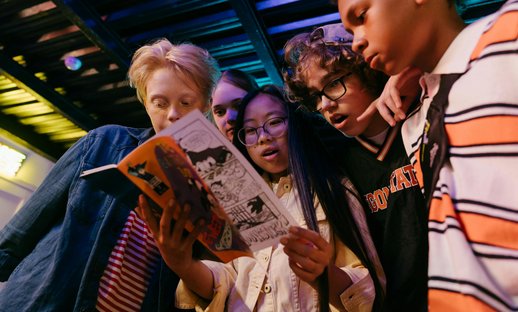
Children make sense of the world around them through stories. Creative storytelling involves children making up their own stories based on their interests, experiences and imagination. Support early years children to tell more stories in your setting by using our top tips.
Ideas and insights to help young children tell their own stories
In this resource we outline a range of practical ideas that you can experiment with and adapt to make the most of the space and resources you have available.
Providing a storytelling culture, where children are encouraged to share their ideas and develop a story line in their play, will result in more stories being told, enabling children to find their own voices, and to test out their storytelling skills.
Find ideas that explore:
- Storytelling together
- Using prompts and role-play resources
- Building up a bank of known and loved stories as a springboard for their own ideas
- Using puppets
- Creating a record of the story, through scribing or technology
- Using your outside area to provide prompts and allow space for more physical acting out of their story.
Remember to model storytelling yourself, with props and different voices, to inspire them.
National Storytelling Week
The ideas here can be used at any time of year, but National Storytelling Week, which takes place each year in late January/early February, provides a fantastic opportunity to focus on supporting children in your early years setting to explore their creativity, try out new vocabulary and build confidence in speaking.
Share stories with me booklet
Our Share stories with me booklet is designed to support parents to look at books and share stories with little ones. The resource provides simple ideas and examples as well as explaining the importance of reading and making up stories together.
Download file
You might also be interested in
-
Free
Download your National Year of Reading termly calendars and phase‑specific resources that support the current termly theme. Plus, find out how to catch up on previous events and...View details about National Year of Reading schools and early years resources and toolkit