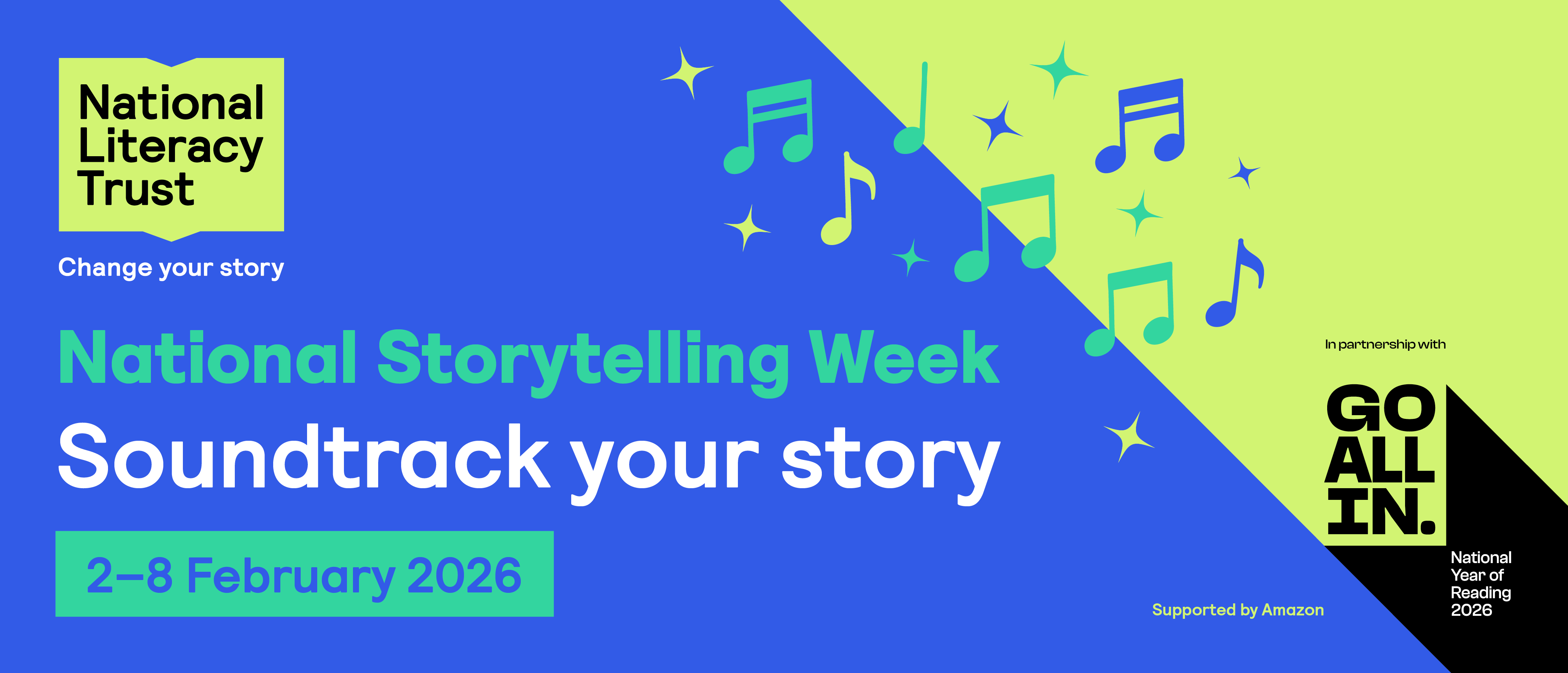
In 2026, we celebrated National Storytelling Week from Monday 2 February to Sunday 8 February.
What is National Storytelling Week?
Created by Society for Storytelling, this fantastic annual event is a joyful celebration of the power of sharing stories. Stories teach us about the world; they allow us to step into someone else’s shoes and feel empathy; they help us to relax and escape and they can help develop essential literacy skills.
National Storytelling Week is a celebration of oral storytelling, reading and writing for pleasure. At a time when young people’s writing and reading enjoyment levels are at their lowest, National Storytelling Week has never been more important.
This year, our exciting storytelling project is supported by Amazon.
Part of the National Year of Reading 2026.
What is the theme for National Storytelling Week 2026?
The theme for National Storytelling Week 2026 was Soundtrack your story. Everyone has their own musical story - whether it’s in the songs we love and the music we dance to, through British Sign Language and the rhythms we feel, the soundscapes of everyday life, or the soundtracks we hear in films and games. Music connects us to words. It helps us express who we are and how we see the world.
Our research highlights that exploring stories through lyrics can be an effective way to re-engage young people with reading for enjoyment and writing for pleasure. Slightly more than 3 in 5 (60.7%) children and young people age 8-18 regularly read song lyrics digitally. Writing song lyrics is also popular among children and young people age 8-18, with slightly less than 1 in 5 (17.8%) reporting that they write lyrics on a screen at least once a month.
Throughout the week, we explored the magic of storytelling through sound, lyrics and rhythm. Who’s ready to pick up the mic?
Take part in National Storytelling Week
Step one: Workshops, videos and resources (early years, primary and secondary)
For each age range, there are pre-recorded videos or live virtual workshops (with recordings to watch after on YouTube) and linked classroom activities to help you deliver storytelling projects with your pupils. All videos have BSL and live captioning. The resources and videos follow the soundtrack your story theme to promote a love of reading, writing and storytelling, in a way that also meets national curriculum requirements for writing. We also have fun, storytelling at home activity ideas for early years settings and primary schools. Follow the links below to access videos and download resources.
Early Years
Rhyme, rhythm and wriggles singalong and storytime with poet Simon Mole and musician Gecko.
KS1/P2-P3
Building stories through sound with Annemarie Anang.
KS2/P4-P7
Exploring storytelling through rap with Alim Kamara.
KS3/S1-S3
Telling your story through music with Jeffrey Boakye.
Step 2: Writing competition
Our National Storytelling Week competition is now closed. We will notify winning students in May.
Prizes
- Winning pupils' writing will be published in a special National Storytelling Week anthology. They will receive a printed copy of the anthology as well as a copy for their school.
- All schools who submit writing will be automatically entered into a prize draw to win a bundle of books.
- Several pupils in KS2/P4-P7 will have the opportunity to have their work performed and recorded by rapper Alim Kamara!

Part of the National Year of Reading 2026
This year, National Storytelling Week will be the first Go All In Together moment for the National Year of Reading. These moments are live events for schools and settings to celebrate reading and literacy, together across the UK.
National Year of Reading is a government backed campaign, initiated by the Department of Education with the National Literacy Trust as its delivery partner. We believe reading is a powerful plug-in to the things you already love – a great way to go deeper into your existing passions. Put simply we say: ‘if you’re into it, read into it’. National Storytelling Week will be an exciting launch into a year of exploring passions through reading and writing.
You can now sign up to all of Spring Term activity for the National Year of Reading 2026 here.
Get in touch
If you have any questions about our activities for National Storytelling Week, please email Young Writers: young.writers@literacytrust.org.uk
What teachers told us last year
“(National Storytelling Week) completely negated the 'I can't think of how to start' that often holds pupils back. The assertion that you just write until something good starts to happen is the most valuable lesson. And so very important to hear it from someone other than a teacher!!”
“One of our dyslexic pupils has previously really worried about the technical aspects of his writing. During this project, he was able to let go and really apply his creativity.”
“Exceptional. Year Five children were so enthusiastic about creating their own narrative after such a stimulating and engaging online event delivered by the author.”